PRESS RELEASE: TGA Says Homosalate and Oxybenzone Can Be Absorbed Through the Skin and “May Cause Harmful Effects”
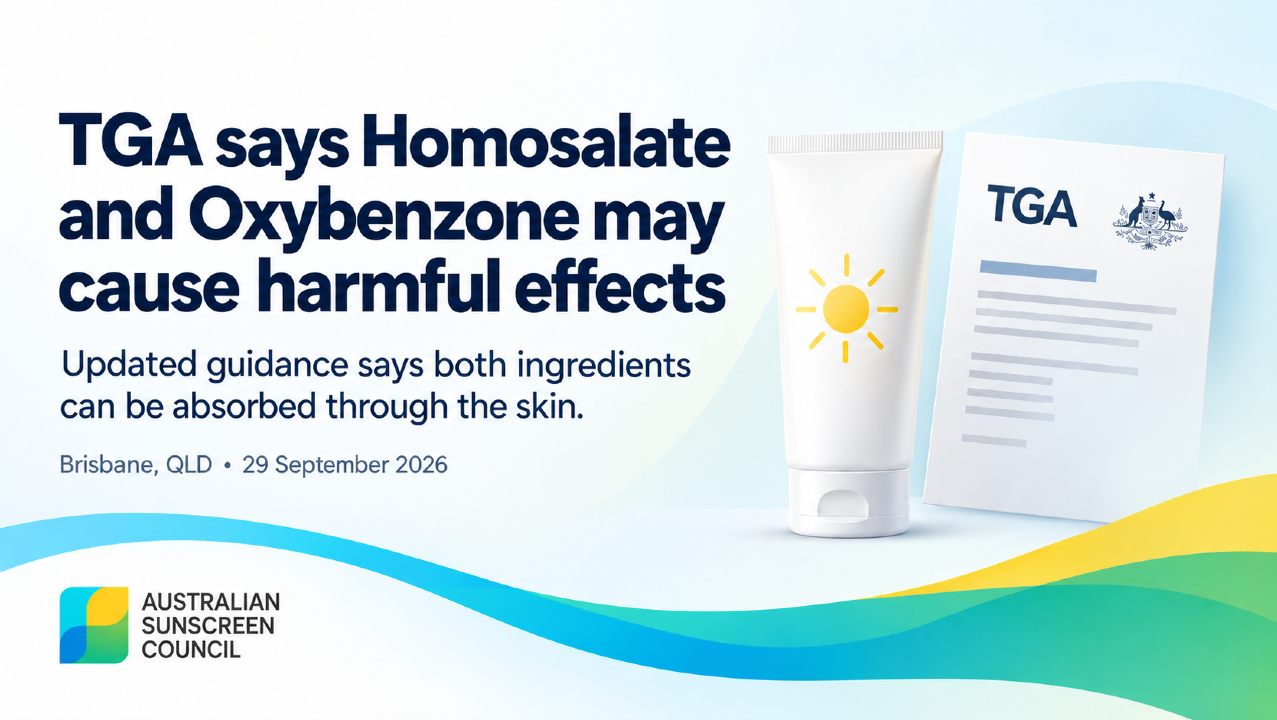
BRISBANE, QLD — 29 September 2026 — Australia’s medicines regulator has updated its public guidance to acknowledge that two chemical sunscreen ingredients can potentially be absorbed through the skin and may cause harmful effects.
On its updated “Sunscreen ingredients” webpage, the Therapeutic Goods Administration (TGA) states: “Homosalate and oxybenzone are active ingredients that can potentially be absorbed through the skin and may cause harmful effects if used in high concentrations, over large areas and over an extended amount of time.” [1]
Australian Medical Association Queensland president Dr Nick Yim has also warned that some sunscreen chemicals could cause harm, telling The Courier-Mail: “While sunscreen plays a vital role in preventing skin cancer, especially in Queensland, with increasing research we now know that some chemicals could cause harm.” [2]
Dr Yim’s comments followed a peer-reviewed Australian study published in Environmental Science & Technology by the American Chemical Society in September 2026. The study analysed 187 pooled urine samples representing approximately 18,700 Australians, collected between 2012 and 2023. [3]
It found that 53% of children’s pooled urine samples, more than half, had levels of the homosalate metabolite HMS-CA5 at or above the HBM-II value, the level at which adverse health effects are possible. [3]
The researchers concluded that the results indicated a need to reduce homosalate exposure in at least some individuals, and supported stricter regulation of homosalate in Australia. [3]
European scientists have already raised concerns about homosalate. In its 2021 Final Opinion on Homosalate, the European Commission’s Scientific Committee on Consumer Safety (SCCS) assessed the ingredient amid concerns about its potential endocrine-disrupting properties, and concluded: “Homosalate is not safe when used as a UV-filter in cosmetic products at concentrations of up to 10%.” [4]
Australia permits homosalate in therapeutic sunscreens at concentrations of up to 15%, which is 50% higher than the 10% concentration the SCCS concluded was not safe. [4][5]
Following the SCCS findings, the European Commission prohibited homosalate completely in body sunscreens and other body products. [6]
Oxybenzone has also been assessed by the SCCS following concerns about its potential endocrine-disrupting properties. [7]
Overseas health authorities increasingly favour mineral sunscreens. The American Academy of Pediatrics advises: “Mineral-based sunscreen (e.g., zinc oxide) is preferable to chemical-based sunscreen (e.g., oxybenzone).” [8]
The United States Food and Drug Administration (FDA) has said the available evidence provides sufficient safety data to support zinc oxide and titanium dioxide as Generally Recognized as Safe and Effective (GRASE) sunscreen active ingredients at concentrations of up to 25%. [9]
In Hawaii, Maui County has prohibited the sale, distribution and use of non-mineral sunscreens without a prescription since 1 October 2022. Under the county’s ordinance, mineral sunscreens are those using zinc oxide or titanium dioxide as their active sunscreen ingredients. [10]
The Australian Sunscreen Council is calling on the TGA to ban homosalate from children’s sunscreens. A Council spokesperson said: “We hope the TGA will act on the growing body of evidence and prohibit the use of homosalate in children’s sunscreens by the end of 2026.”
“We also support the American Academy of Pediatrics’ position that mineral-based sunscreen is preferable to chemical-based sunscreen for children, including mineral sunscreens using ingredients such as zinc oxide.”
About the Australian Sunscreen Council
The Australian Sunscreen Council is Australia’s peak industry body for sunscreen safety and a registered charity. The Council works with scientists, medical professionals, industry experts and policymakers to promote evidence-based sunscreen safety, UV protection education and stronger public-health standards.
Bibliography
[1] Therapeutic Goods Administration (TGA). Sunscreen ingredients. Australian Government Department of Health, Disability and Ageing, updated September 2026. https://www.tga.gov.au/resources/explore-topic/sunscreens/sunscreen-ingredients
[2] The Courier-Mail. Reporting on the Queensland homosalate biomonitoring study and comments from Australian Medical Association Queensland president Dr Nick Yim, September 2026.
[3] Ebert, K.E. et al. “Assessing UV Filter Exposure in Queensland, Australia: Human Biomonitoring Evidence Highlighting Homosalate in Children.” Environmental Science & Technology, 2026. DOI: 10.1021/acs.est.6c09445. https://pubs.acs.org/doi/10.1021/acs.est.6c09445
[4] Scientific Committee on Consumer Safety (SCCS), European Commission. Opinion on Homosalate (CAS No. 118-56-9, EC No. 204-260-8). SCCS/1622/20, final opinion adopted 24–25 June 2021. https://health.ec.europa.eu/publications/homosalate_en
[5] Therapeutic Goods Administration (TGA). Safety review of seven active sunscreen ingredients. Australian Government, 8 July 2025. https://www.tga.gov.au/resources/publication/corporate-reports/safety-review-seven-active-sunscreen-ingredients
[6] European Commission. Commission Regulation (EU) 2022/2195 of 10 November 2022. Official Journal of the European Union. https://eur-lex.europa.eu/eli/reg/2022/2195/oj
[7] Scientific Committee on Consumer Safety (SCCS), European Commission. Opinion on Benzophenone-3 (CAS No. 131-57-7, EC No. 205-031-5). SCCS/1625/20, final opinion adopted 30–31 March 2021. https://health.ec.europa.eu/publications/benzophenone-3_en
[8] American Academy of Pediatrics. Chemical Exposure from Personal Care Products. https://www.aap.org/en/patient-care/environmental-health/promoting-healthy-environments-for-children/personal-care-products/
[9] U.S. Food and Drug Administration. Questions and Answers: FDA’s Regulatory Actions on Over-the-Counter Sunscreen. https://www.fda.gov/drugs/understanding-over-counter-medicines/questions-and-answers-fdas-regulatory-actions-over-counter-sunscreen
[10] County of Maui. Mineral Only Sunscreen Maui County. Ordinance No. 5306. https://www.mauicounty.gov/sunscreen