
MeOH Weekly Liquid Fuel Markets Update – w/e 06.11.2026: Crude Oversupply as the Dragon Kicks the Crude Habit
Issued by MeOH Energy
China’s declining oil demand, US political change and renewed hopes of Middle East diplomacy combine to deliver the sharpest weekly crude price correction since 2022.
Global liquid fuel markets experienced an extraordinary week of volatility, with international crude oil prices falling approximately 13% as improving supply conditions collided with weakening demand and changing geopolitical expectations.
Three developments dominated the market:
• China’s declining appetite for crude oil, driven by accelerating transport electrification and reduced petroleum consumption.
• The US midterm elections and renewed US–Iran diplomatic initiatives, raising expectations of a negotiated reduction in Middle Eastern hostilities.
• Emerging global crude oversupply, with weakening demand and recovering production challenging the supply constraints that have dominated international markets throughout 2026.
For Australia, however, the sharp correction in international crude prices has yet to deliver equivalent relief at the retail fuel pump.
Global Crude Oil Prices
Indicative Market View: Sharply Lower / Highly Volatile
Benchmark Closing Price USD/bbl
Brent Crude $98.32
West Texas Intermediate (WTI) $90.34
Market Outlook
Crude Oil: Lower / Highly Volatile
Diesel: Elevated / Supply Constrained
Petrol: Elevated / Potential Downward Pressure
Aviation Fuel: Firm / Sensitive to Refining Capacity
International crude markets recorded their largest weekly percentage decline since 2022, as traders reassessed the geopolitical risk premium built into prices during months of Middle Eastern conflict.
The US midterm elections delivered significant Democratic gains, increasing expectations that domestic political pressure over inflation and energy costs could encourage Washington to pursue a diplomatic resolution with Iran.
Reports of renewed negotiations through Qatari intermediaries further strengthened market expectations that restrictions affecting the Strait of Hormuz could eventually ease.
While a negotiated settlement remains uncertain, the possibility of restoring more normal Middle Eastern petroleum exports has materially altered market sentiment.
Importantly, the decline in crude prices also reflects a changing underlying supply-and-demand balance.
China – The Dragon Kicks the Crude Habit
The world’s largest crude oil importer is undergoing a structural change in transportation energy consumption that could have profound implications for global petroleum markets.
Recent research from the Centre for Research on Energy and Clean Air indicates that China’s carbon emissions declined approximately 3.1% during the latest reporting quarter, accompanied by falling oil consumption and reduced demand for transportation fuels.
The principal driver is the extraordinary pace of China’s transition towards electric transportation.
Electric vehicles reportedly accounted for approximately 67% of new passenger vehicle sales and around 50% of new heavy-truck registrations, substantially reducing the growth in demand for conventional petrol and diesel.
This transition is particularly significant because China’s industrialisation and expanding vehicle fleet have been major drivers of global petroleum demand growth for more than two decades.
China has also drawn upon substantial domestic petroleum inventories during periods of elevated international prices, reducing its immediate dependence upon imported expensive conflict crude.
The combination of structural demand changes and inventory management is altering the balance of the global petroleum market.
China is not abandoning oil. However, its transport sector is becoming progressively less dependent upon it.
For international crude producers, that distinction matters.
A market accustomed to sustained Chinese demand growth may increasingly need to compete for a smaller share of incremental consumption.
Global Crude Supply Moves Towards Surplus
Further evidence of changing market conditions emerged during the week, with J.P. Morgan reportedly estimating that global crude oversupply widened to approximately 1.4 million barrels per day during October.
High petroleum prices have constrained consumption while improving Middle Eastern export flows and recovering production have increased available supply.
Short-term Brent physical market pricing also showed signs of contango, a condition in which near-term oil prices trade below prices for later delivery.
This can indicate that immediate physical supply is becoming more readily available relative to demand.
Saudi Aramco’s decision to reduce official selling prices for December crude shipments to Asian customers provides another indication of increasing competition between producers.
The combined developments suggest that the global crude market is moving away from the acute supply constraints experienced earlier in the year.
However, the distinction between crude oil availability and refined petroleum product availability remains important.
Additional crude supply does not automatically translate into additional diesel, petrol or aviation fuel.
Refining capacity, shipping availability and international distribution infrastructure continue to influence the price and availability of finished transportation fuels.
Australia – Relief at the Bowser Remains Elusive
Indicative Market View: Elevated Prices / Delayed Response to Crude Correction
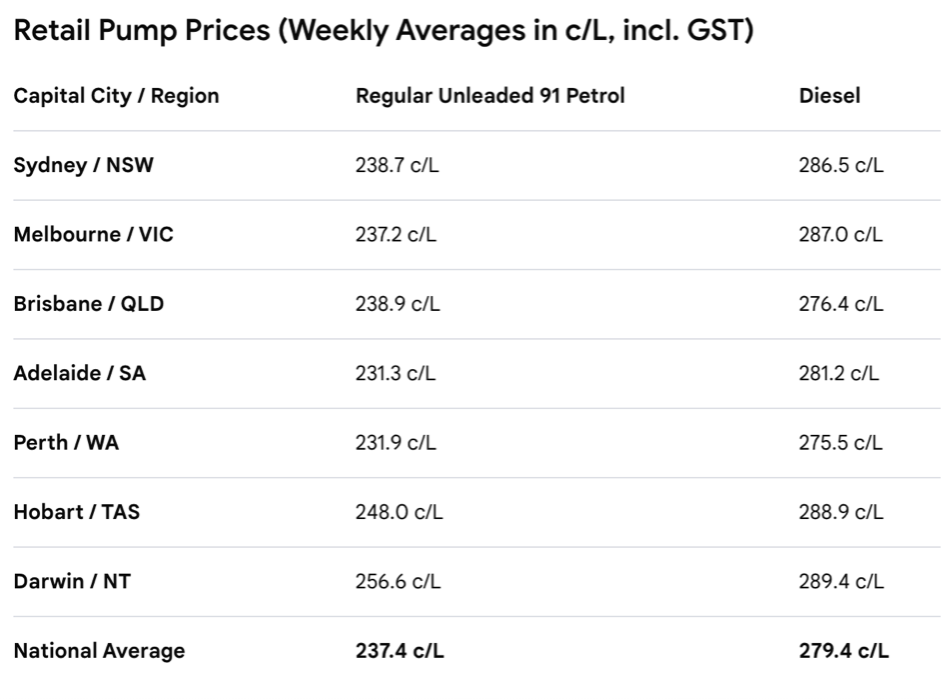
Despite the sharp decline in international crude oil prices, Australian wholesale and retail fuel prices remained substantially elevated during the week.
Indicative domestic prices for the week ended 6 November were:
Fuel Retail Price Range
U91 Petrol – 231.3–256.6 c/L
Diesel – 275.5–289.4 c/L
Australian diesel prices continue to command a substantial premium over petrol, reflecting the continuing pressure on international middle-distillate markets.
The difference is particularly significant for Australia’s freight transport, mining, agriculture and construction sectors, where diesel remains an essential operating input.
Movements in international crude oil prices do not translate immediately into Australian retail prices.
Domestic wholesale fuel prices are influenced by Singapore refined-product benchmarks, currency movements, freight costs and distribution arrangements, while retail prices generally respond with a further delay.
Consequently, the substantial decline in international crude prices may provide some relief over coming weeks, provided lower prices are sustained and international refined-product markets respond accordingly.
Australia’s Fuel Security – A Structural Challenge
MeOH Energy Chairman Simon Tolhurst said the week’s developments demonstrated how quickly international petroleum markets could change direction.
“The market has moved from concerns about insufficient crude supply to growing expectations of oversupply in a remarkably short period,” Mr Tolhurst said.
“China’s changing transportation energy requirements are particularly important because they represent a structural change in demand, rather than simply another short-term market adjustment.
“However, for Australia, lower international crude prices do not eliminate our dependence upon overseas refineries, international shipping and imported finished fuels.”
MeOH Energy CEO Michael ‘Mick’ Spencer said the distinction between international crude oil availability and Australia’s domestic fuel production capability remained fundamental.
“Australia cannot control Chinese oil demand, American foreign policy or the geopolitical events that determine international petroleum prices,” Mr Spencer said.
“What we can control is our capacity to manufacture more of the transportation fuels we consume.”
“Even if global crude markets move into sustained oversupply, Australia will remain dependent upon imported refined fuels unless we invest in additional domestic production capability.”
“Lower prices are welcome. But lower prices should not be mistaken for greater fuel security.”
“Australia has the resources, industrial capability and technology to reduce its dependence upon imported transportation fuels,” Mr Spencer said.
“Australia has an opportunity to pursue a commercially proven pathway towards stronger energy security, advanced manufacturing and lower-emission transportation fuels.”
ENDS
About MeOH Energy

For further information: John Kochanski, CMO e [email protected] m +61 (0)411 831 122 MeOH Energy Australia exports three times more energy than it consumes, yet imports 91% of its liquid transportation fuels. MeOH Energy's advanced carbon transformation technology converts a wide range of stranded carbon resources into sustainable, low-emission liquid transportation fuels: end-of-life tyres, agricultural residues, biomass, plastics, paper, fibre and other carbon resources can all be converted into valuable liquid fuels, keeping valuable carbon resources in the Australian economy instead of sending them to landfill, while strengthening Australian industry and agriculture and reducing environmental impacts. Australia has an opportunity to pursue a commercially proven pathway to stronger energy security, advanced manufacturing and lower-emission transportation fuels.