PRESS RELEASE: DOREX WEEKLY GOLD MARKET UPDATE – w/e 23.10.26: How Much Can Gold Bear?
Week in Review (Gold Price – USD/oz)
• High: USD $4,143.40
• Low: USD $3,986.73
• Average: USD $4,065.00
• Close: USD $3,994.60
Gold prices retreated during the week ended 23 October 2026, closing below the psychologically important USD 4,000 per troy ounce level as rising energy prices, renewed inflation concerns and changing US interest rate expectations challenged investor sentiment.
A Market Confronted by Competing Pressures
Gold continues to navigate an increasingly complex global economic environment in which traditional safe-haven demand is being challenged by the financial consequences of geopolitical instability.
Escalating tensions in the Middle East, including reported attacks on Saudi Arabian oil infrastructure and renewed friction between Washington and Tehran, contributed to a sharp increase in global crude oil prices.
Higher energy costs have reignited inflation concerns, raising expectations that the US Federal Reserve may need to maintain restrictive monetary policy for longer than previously anticipated.
The resulting upward pressure on US Treasury yields and the US dollar has weighed on gold, despite the geopolitical uncertainty that would ordinarily support demand for the precious metal.
When Financial Markets Need Liquidity
Adding to the week’s pressure was renewed weakness in global equity markets, particularly technology and artificial intelligence-related stocks.
As equity valuations declined, some institutional investors reportedly liquidated gold holdings to meet margin requirements and restore portfolio liquidity.
This illustrates an important distinction between gold’s short-term market price and its longer-term role as a store of wealth.
“Gold is being tested by a combination of forces that would ordinarily be expected to support its value,” said Dorex CEO John Kochanski.
“Geopolitical instability is driving energy prices higher, while the resulting inflation concerns are supporting interest rates and the US dollar. At the same time, volatility in equity markets is creating demand for immediate liquidity.”
“In providing immediate liquidity when financial markets are under pressure, gold is doing precisely what it has done for generations — serving as a reliable store of wealth that can be called upon when needed.”
“These competing pressures are influencing gold’s short-term pricing, but they do not necessarily diminish the underlying reasons investors and sovereign institutions continue to hold physical gold.”
Central Banks Maintain Their Strategic Position
Against this backdrop, official gold reserves provide an important perspective on longer-term market fundamentals.
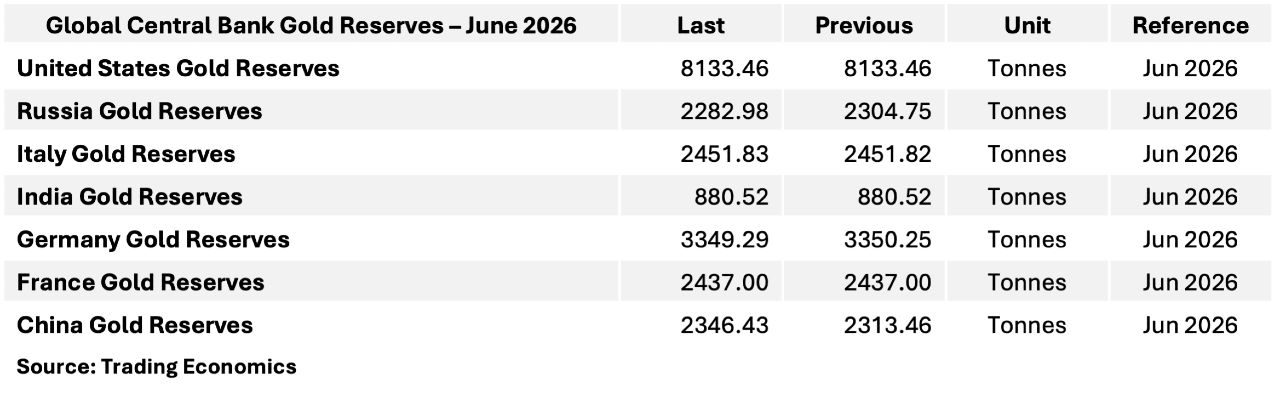
Central bank reserve data for June 2026 showed China increasing its reported holdings by approximately 33 tonnes to 2,346 tonnes, while several other major economies maintained relatively stable holdings, reinforcing the distinction between short-term financial market trading and the strategic allocation of national reserves.
Gold remains an important component of sovereign financial security, particularly as governments seek to manage currency exposure, geopolitical uncertainty and longer-term economic risks.
Looking Beyond the Weekly Close
The coming weeks may bring further volatility as investors assess US monetary policy, energy prices and the potential economic consequences of continuing Middle East instability.
Emerging concerns surrounding the availability and cost of international oil tanker capacity could introduce another complication for global energy markets, adding to inflationary pressures and uncertainty surrounding international trade.
“Gold’s weekly closing price is one measure of market sentiment. Its enduring role in preserving wealth and providing financial security is another,” Mr Kochanski said.
“The liquidation of gold holdings to meet financial obligations should not necessarily be interpreted as a loss of investor confidence in the metal.”
“The question for long-term investors is not simply how much volatility gold can withstand, but how much uncertainty the global financial system can absorb.”
ENDS