PRESS RELEASE: ACCC Reviewing Woolworths ‘Kids’ Sunscreen After Complaint Involving UV Filter Banned in 78 Countries
BRISBANE, QUEENSLAND, AUSTRALIA, June 10, 2026 — The Australian Sunscreen Council has lodged a complaint with the Australian Competition and Consumer Commission (ACCC) about how Woolworths labels its private-label “Kids” sunscreen. The ACCC has acknowledged the complaint (reference REF4740988) and advised that it is currently assessing the matter.
What the complaint is about
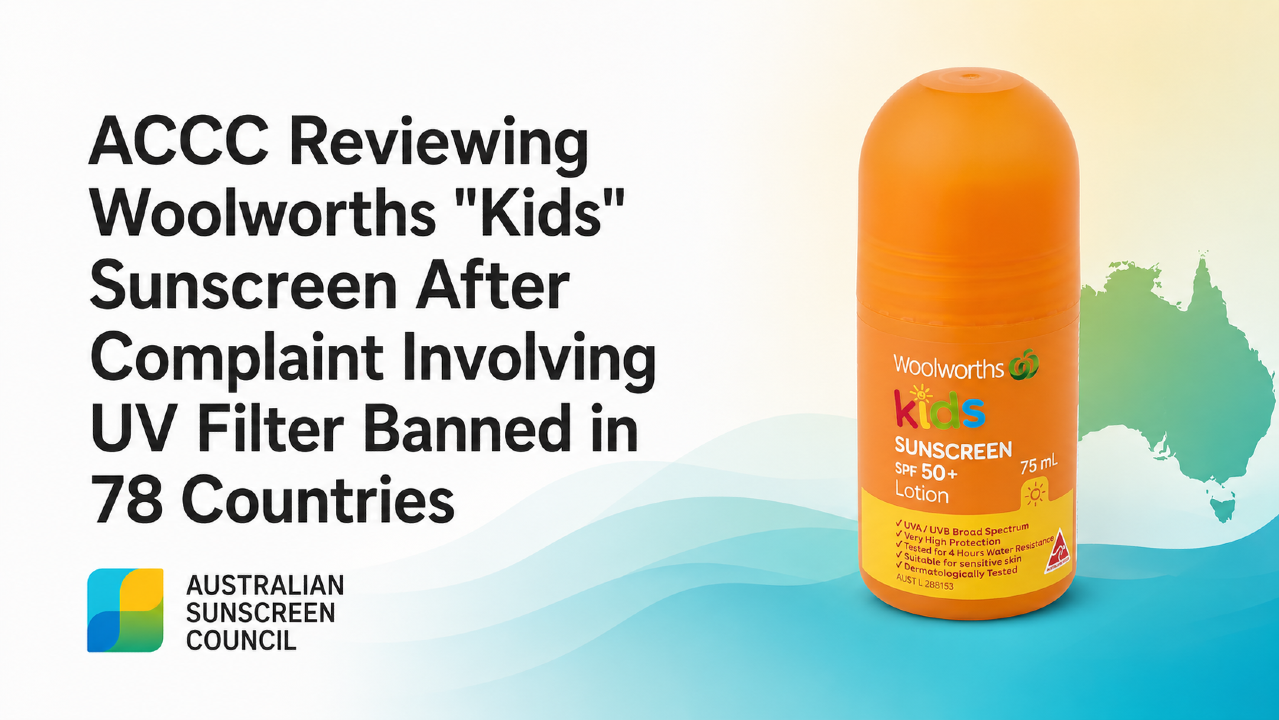
Woolworths sells sunscreens badged “Kids,” presented as though they have been specially formulated for children. The complaint’s case is that they have not been: the only thing separating Woolworths’ Kids SPF50+ Roll On (75mL; AUST L 288153) from its ordinary SPF50+ Everyday Lotion is that the children’s product adds 4-MBC at 4% while the adult product contains none — and 4-MBC is a heavily scrutinised UV filter, currently under safety review by the TGA and banned or refused approval in 78 countries.
The precedent: Nurofen
This is the same kind of conduct the courts have already penalised. In ACCC v Reckitt Benckiser (Australia) Pty Ltd [2016] FCAFC 181 — the “Nurofen Specific Pain” case — the Full Federal Court imposed a $6 million penalty, then the largest ever for misleading conduct under the Australian Consumer Law, because Nurofen sold separate “Migraine,” “Tension Headache,” “Period” and “Back Pain” products as if each were made for that specific pain when they were identical inside and no more suited to one pain than another. The complaint says Woolworths’ “Kids” labelling raises the same question: a product sold as being for a particular group of people without having been made any more suitable for them.
What the complaint asks for
The complaint asks the ACCC to use its power under section 155 of the Competition and Consumer Act 2010 to make Woolworths hand over the evidence behind the “Kids” label — whatever the company relied on to present these products as suitable for, or formulated for, children. The ACCC took similar action on sunscreen marketing in 2025, taking Edgewell Personal Care to the Federal Court (NSD1089/2025) over “reef friendly” claims on Banana Boat and Hawaiian Tropic, where Deputy Chair Catriona Lowe said businesses “must be able to substantiate any claims.”
Why the added ingredient is the issue
The reason 4-MBC matters to the label is that, far from being a children’s ingredient, it is one regulators worldwide have moved away from. 4-MBC is banned or refused approval as a sunscreen active across the European Union, the United Kingdom, the United States (it is not on the FDA’s approved list), Japan, Denmark and the ten ASEAN nations. Denmark specifically has advised against using it on children under 12 since 2001. The EU’s Scientific Committee on Consumer Safety found it may act as an endocrine disruptor, and the TGA’s January 2026 evaluation (Submission ID IN-2025-AP-000920) accepted that no safe dose for 4-MBC can be calculated. A recent 9News investigation reported 4-MBC is still in more than 100 Australian sunscreen products, including children’s and baby ranges.
“When a company markets a product specifically for children, parents are entitled to know what that claim is based on. Woolworths includes 4-MBC in its kids’ sunscreen but leaves it out of its adult everyday sunscreen, which raises an obvious question about what makes the children’s version suitable for children. We have simply asked the ACCC to examine what evidence the company held when it made that claim. The TGA found in January that there is no safe dose for this chemical — so it is surprising to see it in a sunscreen marketed to children.” — Joseph Mizikovsky
Status
The ACCC acknowledged the complaint on 4 June 2026 under reference REF4740988 and advised that an officer will be in contact in due course. The Council awaits the outcome of the ACCC’s assessment. The ACCC has made no finding against Woolworths.