
PRESS RELEASE: Weekly Update – Global Fertiliser Markets – w/e 30.10.2026: Global fertiliser markets divide as ammonia prices rise while urea, phosphates and potash face downward pressure
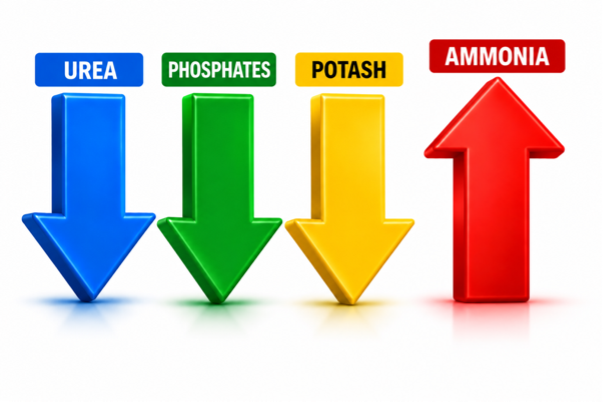
• UREA: Prices remain under pressure as India delays announcing its next major tender, although market speculation points to an imminent tender for 2.5 million metric tonnes (MT).
• PROCESSED PHOSPHATES: High prices continue to discourage purchasing, with buyers increasingly substituting lower-cost alternatives for traditional DAP and MAP fertilisers.
• POTASH: Abundant supply, elevated inventories and slowing Chinese demand are contributing to a weaker global price outlook.
• AMMONIA: November contract prices have risen USD 95 per metric tonne, reflecting escalating European gas costs and reduced regional production.
UREA – Softening
Indicative Market View – Prices Under Pressure
• China – Prilled Urea: USD 345–350 PMT FOB netback
• Middle East – Granular Urea: Approximately USD 440 PMT FOB
• Egypt: Approximately USD 535 PMT FOB
• Brazil – Non-Chinese Urea: USD 480–485 PMT CFR
• Brazil – Chinese Urea: USD 470–475 PMT CFR
• US/NOLA – November Barge: Approximately USD 475 PMT
• Thailand: Approximately USD 450 PMT CFR
Global urea markets remained subdued during the week, with limited purchasing activity and continuing uncertainty surrounding India’s anticipated return to the international market.
India remains the principal focus for traders and producers, with expectations of another major tender potentially approaching 2.5 million MT.
However, the approaching Diwali festivities have raised questions about the timing of an announcement, although market rumours suggest a tender could be announced imminently.
Indications suggest a potential Level 1 (L1) benchmark of USD 370–375 PMT CFR, providing Chinese producers with netbacks of approximately USD 345–350 PMT FOB.
The anticipated tender follows the disappointing outcome of India’s previous purchasing programme, which secured only 410,000 MT against substantially higher requirements.
Elsewhere, disruptions affecting the Strait of Hormuz continue to restrict Middle Eastern exports, with only limited cargoes moving through the contested waterway.
Oman’s OMIFCO remains among the few regional producers actively exporting, while limited Saudi Arabian volumes are moving through the Red Sea port of Yanbu.
Egyptian urea prices remain comparatively strong at approximately USD 535 PMT FOB, supported by European demand and elevated natural gas costs.
European producers face increasing pressure to curtail ammonia production, with consequential implications for regional urea manufacturing.
Brazilian demand remains subdued, with some market estimates suggesting 2026 urea imports could finish 20–30% below normal levels. The country’s principal purchasing season is also approaching its conclusion.
In Southeast Asia, Malaysian producer Petronas and Brunei Fertilizer Industries (BFI) remain cautious about export commitments, although reports suggest a possible BFI shipment to Australia at slightly below USD 440 PMT FOB.
“Purchasing seasons are ending in Australia, Thailand and Brazil,” said AFC CEO Mr Stein Haugan.
“Attention is now shifting towards anticipated demand from the United States and Europe.”
Outlook: Urea prices are expected to remain under pressure until India’s next tender establishes a clearer market benchmark.
PROCESSED PHOSPHATES – Stable to Soft
Indicative Market View – Prices Under Pressure
• India – DAP: USD 890–900 PMT CFR
• Brazil – MAP: USD 830–850 PMT CFR
• North America – Retail DAP/MAP: Approximately USD 925–967 per US ton
Global processed phosphate markets remain characterised by elevated prices, constrained supply and growing resistance from agricultural buyers.
“While raw material costs and restricted export availability continue to support prices,” said Mr Haugan, “increasingly cautious purchasing behaviour is placing downward pressure on the market.”
Farmers in several major agricultural regions are reducing phosphate applications or switching to lower-cost alternatives as fertiliser affordability becomes an increasing concern.
In Europe, phosphate purchasing is reportedly at least 30% below normal seasonal levels, while Brazilian import demand remains exceptionally weak.
An increasingly significant development is the substitution of Triple Superphosphate (TSP) for traditional Diammonium Phosphate (DAP) and Monoammonium Phosphate (MAP).
TSP offers an alternative source of phosphorus without requiring ammonia in its manufacture, making it increasingly attractive where high nitrogen and sulphur costs are affecting traditional phosphate prices.
Supply constraints nevertheless remain significant.
Disruptions affecting sulphur shipments through the Strait of Hormuz continue to influence production costs, while restricted Chinese exports are limiting international availability.
Reports have also emerged of a possible government-to-government agreement between Bangladesh and China involving 460,000 MT of DAP, although no official confirmation has been announced.
In Brazil, buyers continue to resist prevailing MAP prices as the principal purchasing season concludes, while Indian DAP prices remain comparatively stable despite subdued demand.
Outside agriculture, growing demand for purified phosphoric acid and iron phosphate from the lithium iron phosphate battery industry is creating an additional market for phosphorus-based products.
Outlook: Processed phosphate prices are expected to remain under pressure as weakening agricultural demand offsets restricted supply. Increasing substitution towards TSP could further influence traditional DAP and MAP markets, although raw material and logistics constraints are likely to moderate the pace of any price reductions.
POTASH – Softening
Indicative Market View – Bearish
• Brazil – Granular MOP: USD 355–375 PMT CFR
• Southeast Asia – Standard MOP: USD 360–370 PMT CFR
• Southeast Asia – Granular MOP: USD 380–390 PMT CFR
• North America – Retail Potash: Approximately USD 490–505 per US ton
Global potash markets continued to soften during the week, with abundant supply, elevated inventories and slowing Chinese purchasing activity contributing to a generally bearish outlook.
Unlike nitrogen and phosphate markets, where production costs and supply disruptions remain significant influences, potash availability is comparatively strong.
Brazilian Granular Muriate of Potash (MOP) prices have eased to approximately USD 355–375 PMT CFR, representing a reported decline of around 10% over the past two months.
Purchasing activity is slowing as Brazil’s principal soybean planting season approaches completion, with buyers increasingly relying on existing inventories rather than committing to additional volumes.
Brazil imported approximately 10.8 million MT of potassium chloride during the first nine months of 2026, representing a 3.6% decline compared with the corresponding period last year.
Canadian producers continue to maintain substantial supply into Brazil, providing stability despite weaker purchasing activity.
In Southeast Asia, agricultural demand remains comparatively resilient.
“Oil palm plantations in Indonesia and Malaysia continue to support underlying consumption, while rice and horticultural production provide additional demand,” said Mr Haugan.
Standard MOP prices are holding around USD 360–370 PMT CFR, with granular product attracting premiums of approximately USD 380–390 PMT CFR.
However, higher freight and logistics costs continue to influence delivered prices, particularly for material originating from Russia and Belarus.
Looking further ahead, additional global production capacity is expected to place increasing pressure on the market.
“Industry estimates suggest approximately 15 million MT of new capacity could enter the international market between 2027 and 2030, raising the prospect of sustained oversupply unless demand increases correspondingly,” Mr Haugan said.
Outlook: Potash prices are expected to remain stable to soft in the near term, with high inventories and slowing purchasing activity weighing on market sentiment. Longer-term capacity expansion could place additional downward pressure on prices, although freight costs and established agricultural demand may provide some support.
AMMONIA – Firming
Indicative Market View – Prices Strengthening
• US/Tampa – November Contract: USD 645 PMT CFR
• Northwest Europe: USD 710–730 PMT CFR
• China – Export Ammonia: USD 510–535 PMT FOB
• India – Indicative Buyer Resistance: Above USD 520 PMT CFR
Global ammonia prices strengthened during the week, with the most significant development being the November contract settlement between Yara and Mosaic at USD 645 PMT CFR Tampa.
The settlement represents an increase of USD 95 PMT over October, reflecting mounting pressure on international ammonia availability.
“European natural gas prices remain the principal driver,” said Mr Haugan.
“Elevated gas costs are making regional ammonia production increasingly uneconomic, encouraging manufacturers to reduce output and increasing demand for imported product.”
Forward European TTF gas prices reportedly exceeded EUR 100 per megawatt-hour before easing slightly, placing further pressure on the region’s nitrogen fertiliser industry.
Industry estimates suggest approximately one-third of European ammonia production capacity has been curtailed as manufacturers respond to escalating energy costs.
Consequently, Northwest European ammonia prices have strengthened to approximately USD 710–730 PMT CFR.
Higher European import requirements are also supporting prices in North Africa, where producers are benefiting from stronger international demand.
East of Suez, Chinese ammonia export prices are reportedly ranging between USD 510–535 PMT FOB, supported by regional purchasing activity.
Indian buyers, however, remain resistant to prices above approximately USD 520 PMT CFR, reflecting continuing affordability concerns.
Meanwhile, ammonia demand from phosphate producers remains relatively subdued, with elevated sulphur costs placing pressure on manufacturing economics
.
Despite this resistance, reduced European production and increasing reliance on imported ammonia are expected to continue supporting international prices.
Outlook: Ammonia prices are expected to remain firm, with further increases possible if European gas costs remain elevated and additional production capacity is curtailed. The growing disparity between regional energy costs is likely to remain a significant influence on international ammonia trade.
Global fertiliser markets highlight the importance of energy costs and supply security.
Australian Fertilizer Corporation CEO Stein Haugan said the contrasting performance of global fertiliser markets demonstrated the continuing influence of energy costs, international trade restrictions and agricultural purchasing cycles.
“While urea, phosphates and potash are facing downward price pressure, ammonia prices are moving in the opposite direction, primarily because of the increasing cost of natural gas and reduced manufacturing capacity in Europe.”
“The USD 95 per metric tonne increase in the November Tampa ammonia contract demonstrates how quickly production constraints can influence international fertiliser prices.”
“At the same time, India’s anticipated urea tender highlights the significant influence individual countries can have on global pricing, particularly when international purchasing activity is otherwise subdued.”
“For Australia, these developments reinforce the importance of establishing reliable domestic fertiliser production capacity.”
“Australian agriculture remains dependent on international supply chains that are influenced by geopolitical developments, energy availability and purchasing decisions in markets over which we have no control.”
“Developing domestic manufacturing capability provides an opportunity to reduce that exposure while supporting Australia’s long-term agricultural productivity and supply security,” Mr Haugan said.
ENDS