
PRESS RELEASE: MeOH Weekly Liquid Fuel Markets Update – w/e 30.10.2026: Transportation Fuels – Why Petrol and Diesel Respond Differently to Price Pressures
Elastic vs Inelastic Demand.
Global Crude Oil Prices at Close – w/e 30.10.2026 (USD/bbl)
• Brent Crude: US$117.64/barrel
• West Texas Intermediate (WTI): US$104.12/barrel
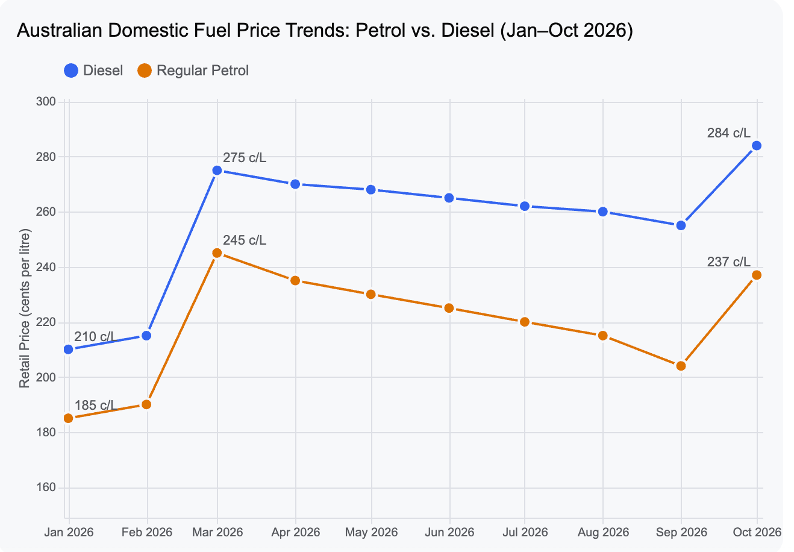
Indicative Retail Fuel Prices – Australia
• Unleaded Petrol (U91): 230.0–238.5 cents/litre
• Diesel: Approximately 276.6 cents/litre
Each week, MeOH Energy’s Global Liquid Fuel Markets Update seeks to examine not only the major developments influencing international energy markets, but also the underlying economic and commercial factors that receive less attention in mainstream media reporting.
Last week’s update examined the emerging global shortage of available oil tankers and its implications for Australia’s tanker-dependent transportation-fuel security.
This week, MeOH examines another important market dynamic: the difference between Elastic and Inelastic demand, and why understanding this distinction helps explain the different pricing pressures experienced by petrol and diesel consumers.
Economists describe demand as Elastic when consumers can readily reduce consumption in response to higher prices. Demand is Inelastic when consumption is less responsive to price increases, particularly where the product is essential to continuing economic activity.
For motorists, higher petrol prices may encourage fewer discretionary journeys, car-pooling, greater use of public transport or postponing non-essential travel.
For commercial diesel users, the choices are considerably more limited.
A trucking company transporting groceries between Melbourne and Brisbane cannot simply park its vehicles up until diesel prices decline. Farmers cannot indefinitely postpone planting or harvesting, livestock must reach markets, and mining and construction operations require reliable fuel supplies to maintain production.
Consequently, commercial diesel demand is considered Inelastic demand.
This distinction is particularly important when international supply becomes constrained. Where demand cannot readily adjust, supply shortages can translate into disproportionately large price increases.
Demand elasticity is therefore another important consideration alongside the Strait of Hormuz, Saudi Arabia’s East-West Oil Pipeline, Houthi attacks on energy infrastructure and the increasingly constrained global tanker fleet.
Global Crude Oil Markets – Geopolitical Risk Supports Prices
International crude oil prices finished October higher, with Brent crude settling at US$117.64 per barrel and West Texas Intermediate at US$104.12 per barrel.
Brent gained approximately 13.6% over October, while WTI advanced 15.2%, reflecting continuing concerns over Middle Eastern energy supplies and international shipping security.
Market attention increasingly focused on reports of potential further US military action against Iran following the November US midterm elections.
Renewed attacks on Saudi Arabian energy infrastructure, together with further incidents involving tankers in the Strait of Hormuz, reinforced concerns over the security of international petroleum supply chains.
Global Supply – Infrastructure and Shipping Remain Vulnerable
The week’s developments highlighted the vulnerability of energy infrastructure and maritime transportation routes.
Houthi forces claimed attacks against Saudi Arabian energy facilities, including the Ras Tanura and Rabigh refineries, while a tanker operating in the Strait of Hormuz was reportedly struck by explosives attached from a small vessel.
These developments add to the transportation constraints examined in last week’s MeOH update.
Meanwhile, declining US crude inventories and stronger Chinese import demand have contributed to concerns over the availability of petroleum supplies.
Collectively, these developments illustrate how production, refining, transportation and demand interact to influence international energy prices.
Australian Wholesale and Retail Fuel Markets – Diesel Remains Elevated
Australian petrol and diesel consumers continue to experience elevated fuel prices, although the underlying market dynamics differ.
Indicative retail petrol prices across major capital cities ranged between approximately 230.0 and 238.5 cents per litre, reflecting differences in local retail pricing cycles.
Diesel remained substantially more expensive, with an indicative national average of approximately 276.6 cents per litre.
The diesel premium reflects several interacting factors, including international distillate supply constraints, refinery capacity, freight and insurance costs, and continuing demand from commercial transportation, agriculture, mining and industrial operations.
Importantly, the relative inelasticity of commercial diesel demand can reinforce these pressures when available supplies become constrained.
Australia’s dependence on imported refined transportation fuels leaves domestic consumers exposed to international market conditions – a structural vulnerability – compounded by successive governments’ failure to establish an effective sovereign fuel security policy.
Australia’s Economic Exposure – Fuel Costs Extend Beyond the Bowser
Recent reporting has estimated that higher fuel prices associated with international conflict have cost Australian consumers approximately $550 per person since March, representing an aggregate burden of around $14 billion.
The implications extend beyond direct expenditure on petrol and diesel.
Higher transportation costs influence the delivered price of groceries, agricultural products, construction materials and manufactured goods.
For businesses operating essential freight and production services, reducing fuel consumption is frequently not a practical short-term response to higher prices.
Consequently, elevated diesel prices can contribute to broader inflationary pressures, even where household motorists respond to higher petrol prices by reducing discretionary travel.
This distinction is particularly important for an economy geographically dependent on long-distance road transportation.
MeOH Energy – Understanding Demand Reinforces the Case for Domestic Production
MeOH Energy CEO Mick Spencer said the distinction between Elastic and Inelastic fuel demand highlighted an important aspect of Australia’s exposure to international petroleum markets.
“When petrol prices rise, motorists have some capacity to adjust their consumption. They might drive less, combine journeys or postpone discretionary travel.”
“But for Australia’s freight operators, farmers, miners and essential industries, diesel is not discretionary. Trucks must deliver groceries, farmers must plant and harvest crops, and industry must continue operating.”
“These businesses cannot simply suspend operations while waiting for international fuel prices to return to more favourable levels.”
Mr Spencer said the combination of Inelastic commercial fuel demand and Australia’s dependence on imported transportation fuels created a significant structural vulnerability.
“Australia cannot control international oil prices, geopolitical conflicts or global refining capacity. Nor can we materially reduce our need for diesel without affecting essential economic activity.”
“What we can do is progressively increase our capacity to produce transportation fuels domestically, using Australian resources and by increasing domestic refining capacity.”
“Understanding the economics of fuel demand reinforces why sovereign transportation-fuel production is not simply an energy industry opportunity.”
“It is an important component of Australia’s broader economic resilience, and of critical importance to every Australian and every Australian household as they experience increasing monthly mortgage repayments and ever-increasing grocery costs.”
“Australia cannot eliminate its need for transportation fuels. But it can reduce its dependence on importing them,” Mr Spencer concluded.
ENDS