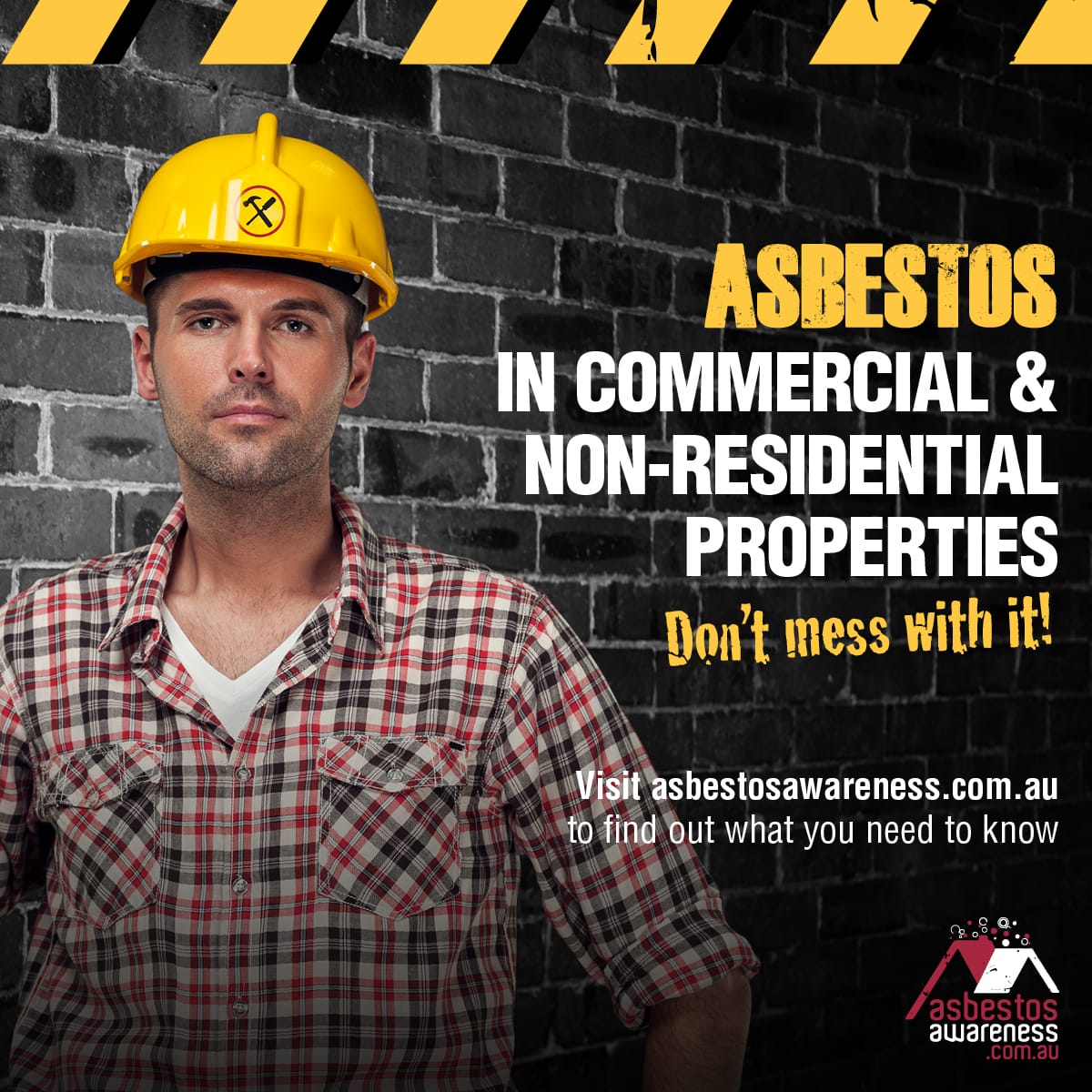
Tradies, Commercial & Non-Residential Property Managers Urged To Respect Asbestos: One Life Lost Every 2 Hours
Issued by Alice Collins - Advocacy Australia

Every two hours and eleven minutes, one Australian dies from an asbestos-related disease caused by exposure to asbestos fibres; that’s over 4000 preventable deaths every year – three times the national road toll – and those who own, manage, maintain and work on commercial and non-residential properties built or refurbished before 2004 can’t afford to ignore the risks.
During National Asbestos Awareness Month (1-30 November) and ahead of Asbestos Awareness Day on Friday 27 November, managers of commercial and non-residential properties and the tradies who work on them are being urged to respect the risks of asbestos and download free resources from asbestosawareness.com.au developed in association with health and safety regulators to ensure the safe, effective management of asbestos-containing materials (ACMs) in accordance with regulations.
Chair of the Asbestos Education Committee, Clare Collins said, “Prior to 2004, asbestos was widely used in the manufacture of over 3000 building and decorator products, meaning a large number of ‘legacy’ ACMs can still be lurking in commercial and non-residential properties built before 2004, as well as in residential homes built or renovated before 1990.
“Despite the asbestos ban in Australia almost 23 years ago, and with around 6 million tonnes of ageing ACMs remaining in our built environment, deaths from exposure to asbestos fibres are rising and will continue to rise if legacy ACMs are disturbed during maintenance, repairs, refurbishments, fit-outs or demolition,” she said.
“Those responsible for managing commercial and non-residential properties, and the tradies who work on them, must adhere to strict asbestos management regulations. However, since launching the campaign in 2011, all too often we’ve heard frightening stories of tradies ignoring the warnings with a ‘she’ll be right’ attitude.
“With asbestos-related deaths projected to increase, tradies and those responsible for managing commercial and non-residential properties must respect the dangers of asbestos, understand the risks and adhere to regulations when managing ACMs,” she said.
In August, the World Health Organization’s (WHO) Asbestos paper reported asbestos in all six forms is carcinogenic, causing a range of cancers including lung, larynx, ovarian and malignant mesothelioma (with no cure), noting “Anyone engaging in construction, maintenance and demolition of buildings where asbestos has been used is potentially at risk even many years or decades after the asbestos was put in place.”
The risks to workers were pointedly clear in a joint study conducted by the WHO and the International Labour Organisation (ILO) which estimated that exposure in the workplace was responsible for over 200,000 deaths globally each year, accounting for more than 70% of all deaths from work-related cancers.
Ms Collins said, “Historically, men such as tradies were more likely to be diagnosed with mesothelioma than women because they were more likely to encounter ACMs in the workplace with the most recent Mesothelioma in Australia Report from the Australian Mesothelioma Registry (AMR), published by the Australian Institute of Health and Welfare (26 August 2026), noted mesothelioma cases have steadily risen over the past 40 years, with 63.3% of men assessed having had both occupational and non-occupational asbestos exposure, while 21% of all those assessed had lived with someone who brought dust into the home.
“Put simply, tradies could be risking their own lives, and the lives of their families including children, when ACMs are disturbed on the job or when asbestos-containing dust is taken home on clothes or tools,” she said.
“For commercial and non-residential property managers and trades, asbestosawareness.com.au provides a breadth of information including, guides tailored to 23 specific trades, Fact Sheets, Asbestos Awareness Toolbox Talks to help employers better inform workers of asbestos risks, and Asbestos Awareness for Young Workers developed in conjunction with SafeWork NSW,” said Ms Collins.
“The Asbestos Product Database also provides tradies and commercial and non-residential property managers with a visual tool to help identify ACMs, and if asbestos is suspected, we recommend using only occupational hygienists or licensed asbestos assessors to confirm asbestos is present through testing.
“While some products are unique to commercial properties, there is definitely cross-over between the uses of ACMs in residential, non-residential and commercial properties, with many of the product types featured on the Asbestos Product Database found across all variations of building construction – from walls and roofing to electrical fuse boxes, floorcoverings, bathrooms and kitchens.
“For commercial and non-residential property managers, the Asbestos Management Handbook for Commercial and Non-residential Properties and templates provide a free, user-friendly asbestos management resource package to help improve regulatory compliance across the sector by providing owners, managers, developers and workers with essential, practical guides and tools to manage ACMs in line with requirements,” she said.
Developed by asbestosawareness.com.au in consultation with stakeholders to improve compliance in the commercial and non-residential property sector, The Handbook was designed for a broad audience including property owners, agents, managers, builders, contractors, subcontractors, tradespeople and workers, covering a wide range of structure types, detailing roles and responsibilities and features best practice case studies and images of ACMs commonly found structures built or refurbished prior to 2004.
The Handbook offers practical step-by-step guidance on adhering to regulations including how to develop and manage an Asbestos Management Plan and Asbestos Register, workers’ training requirements, and defines Asbestos Inspections, Surveys, Risk Assessments and the requirements for asbestos removal.
Phil Smith, Executive General Manager – Environment, Health, Safety and Quality at SHAPE Australia, and member of the Asbestos Education Committee said, “Asbestos management for property owners and people with management and control of facilities can be challenging due to the complex and extensive nature of the regulations, codes, guidelines and standards, and for people unfamiliar with these requirements it can feel overwhelming, leading some to overlook statutory requirements”.
“The free Handbook can assist these individuals by providing a user-friendly step-by-step procedure to guide them through their responsibilities while also limiting the risk to workers and users,” said Mr Smith.
“While the Handbook does not remove the requirement to engage suitably experienced and licensed professionals such as licensed asbestos assessors and removal contractors, it does ensure those responsible for the management of commercial and non-residential properties are aware of their requirements,” he said.
“During National Asbestos Awareness Month I’d implore all people responsible for the management or control of facilities to download the comprehensive Asbestos Management Handbook, Templates and Fact Sheets from asbestosawareness.com.au and ensure they are managing the risks associated with asbestos in line with regulations,” Mr Smith said.
Ms Collins said, “With another Australian life lost to asbestos every two hours and eleven minutes, when it comes to asbestos, Don’t cut it! Don’t drill it! Don’t drop it! Don’t sand it! Don’t saw it! Don’t scrape it! Don’t scrub it! Don’t dismantle it! Don’t tip it! Don’t waterblast it! Don’t demolish it! Don’t dump it! And whatever you do… DON’T remove asbestos yourself – always use licensed asbestos professionals.”
Before taking up tools on any commercial or non-residential property built or refurbished before 2004, visit asbestosawareness.com.au because it’s not worth the risk!
-ENDS-
MEDIA CENTRE
To access asbestos information and resources, images and graphics of asbestos-containing materials, including ACMs in commercial and non-residential properties, please refer to the Media Centre at asbestosawareness.com.au OR via: https://bit.ly/AsbestosAwareness-Media-Centre
• RELEASES & JOURNALIST NOTES: https://bit.ly/AsbestosAwareness-MediaReleases
• IMAGES & GRAPHICS: https://bit.ly/AsbestosAwareness-Images
• FOOTAGE: VNR/BROLL – https://bit.ly/AsbestosAwareness-Footage PLAYLIST: bit.ly/AsbestosAwareness-YoutubePlaylist
INTERVIEW REQUESTS
• For detailed Journalist Notes or to arrange interviews with Phil Smith or a variety of expert spokespersons, contact Advocacy Australia on 02 9518 4744. Email: [email protected]
• Clare Collins: 0414 821 957 [email protected]
• Alice Collins: 0414 686 091 [email protected]
JOURNALIST NOTES
WHAT COMMERCIAL & NON-RESIDENTIAL PROPERTY TYPES ARE AFFECTED AND REQUIRED TO COMPLY WITH REGULATIONS?
Any commercial and non-residential building built or refurbished prior to January 2004 may contain asbestos with owners and managers required to comply with the Asbestos Codes of Practice; How to Manage and Control Asbestos in the Workplace,
How to Safely Remove Asbestos and the Work Health and Safety Consultation Cooperation and Coordination.
There is a wide range of buildings that must comply including shops, commercial (business), industrial (factories and warehouses), government (offices, community and cultural facilities), recreation (sporting facilities), agricultural (farming), hospitality (pubs, restaurants and theatres), health services (hospitals, outpatient buildings, dental and medical practices), education (schools and universities), religious (churches and church halls), transport (waiting areas and sheds), and tourism (accommodation). Asbestos can be anywhere!
MANAGEMENT OF ASBESTOS IN COMMERCIAL & NON-RESIDENTIAL PROPERTIES RESOURCES
The resource package for Asbestos Management for Commercial and Non-Residential Properties was developed in accordance with the Work Health and Safety (WH&S) regulations, the Asbestos Codes of Practice; How to Manage and Control Asbestos in the Workplace, How to Safely Remove Asbestos and the Work Health and Safety Consultation Cooperation and Coordination.
The following Handbook, Templates and Fact Sheets aim to provide those industries most affected by asbestos in commercial and non-residential properties with essential information to increase understanding of the responsibilities associated with asbestos management and the requirements for compliance with government regulations.
All components of the package are free and can be downloaded from asbestosawareness.com.au/commercial
ASBESTOS MANAGEMENT HANDBOOK FOR COMMERCIAL & NON-RESIDENTIAL PROPERTIES
The Handbook is a comprehensive guide providing information on the roles and responsibilities of property owners, managers, contractors, sub-contractors, foreman and workers. It features easy to follow step-by-step instructions on how to develop and implement policies and procedures to assist in identifying and managing asbestos safely and in accordance with regulations.
It includes a list of property types across multiple sectors including government, business (high rise, mid-rise, low rise), industrial, agriculture, recreation, education and more. The Handbook explains complex information in user-friendly, accessible terms and is complemented by Fact Sheets and Templates.
The Handbook also features images of asbestos-containing products commonly found in commercial and non-residential properties. There are 12 dedicated support resources including:
1. Asbestos Management for Commercial and Non-Residential Properties Model Asbestos Management Plan (AMP) Guide Template
2. Asbestos Register Template
3. Asbestos Removal Record Template
4. Workers Training Requirements & Records Template
5. Model Asbestos Policy for Contractors & Builders Template
6. Model Asbestos Management Procedures for Contractors & Builders Template
7. C1 Fact Sheet – Unexpected Asbestos, ACM Finds or Incidents Procedures Flow Chart
8. C2 Fact Sheet – Unexpected Asbestos Finds or Incidents
9. C3 Fact Sheet – Asbestos Management Recommendations and Guidelines
10. C4 Fact Sheet – Using PPE and RPE
11. C5 Fact Sheet – Roles and Responsibilities for the Management of Asbestos and ACM
12. C6 Fact Sheet – 20 Point Safety Check for Contractors, Subcontractors and Workers
ESSENTIAL FACTS FOR TRADIES
With many tradies work on commercial properties either maintaining, repairing or refurbishing them, they should refer to Asbestos Management Handbook for Commercial & Non-Residential Properties as well as resources for residential properties including: asbestosawareness.com.au/tradies
1. T1: 20 POINT ASBESTOS SAFETY CHECKLIST For Tradies Working On Residential Properties
2. T2: A Tradie’s Guide To Safe Practices In Managing Asbestos In Residential Properties
3. Guides tailored to 23 specific trades from air conditioning installers, roofers, fencers, tilers and more
4. T3: A Tradesperson’s Guide to Asbestos Containing Materials in Domestic Properties
5. FS4: Fact Sheet 4 PPE & RPE
INTERVIEW OPPORTUNITIES
PHILLIP SMITH – Executive General Manager EHSQ, SHAPE Australia
Phillip Smith is the Executive General Manager – Environment, Health, Safety and Quality at SHAPE Australia and has more than 30 years’ experience in the construction industry. Throughout his career, Phil has been a strong advocate for asbestos awareness, education and risk management. He is a member of the Asbestos & Hazmat Removal Contractors Association, the OFSC Industry Reference Group and the National Asbestos Awareness Campaign’s Asbestos Education Committee. Phil holds trade, construction, strategic leadership and WHS qualifications and is recognised for his practical approach to safety leadership, governance and organisational improvement.
CLARE COLLINS – Chair, Asbestos Education Committee
Clare Collins is the Director of the National Asbestos Awareness Month campaign and asbestosawareness.com.au. Clare is the Managing Director of Insight Communications, the creators and managers of the Asbestos Awareness campaign since 2011. Working in consultation with government experts and industry leaders, Insight are the creatives behind the multi-award-winning campaign and asbestosawareness.com.au. Clare is also the Chair of Advocacy Australia and the Asbestos Education Committee for the National Asbestos Awareness Campaign.
JOHN BATTY – Former President of the Asbestos & Hazardous-Materials Consultants Association
John Batty is one of the founding members and former President of the Asbestos & Hazardous-Materials Consultants Association (AHCA) and Managing Director of EDP Consultants, a global provider of Health, Safety and Environmental Services. John has more than 20 years’ experience in asbestos and hazardous materials management and is a consultant to a number of government departments and private organisations. John is a member of the Asbestos Education Committee for the National Asbestos Awareness Campaign.
BRET BAKER JP – President, Asbestos & Hazmat Removal Contractors Association of NSW (AHRCA)
Bret Baker is President of the Asbestos & Hazmat Removal Contractors Association of NSW (AHRCA). Bret is a Civil and Environmental Engineer and is the Managing Director of Beasy Pty Ltd with more than 25 years’ experience in asbestos removal and demolition. Bret is a long-time industry representative on a number of government asbestos and demolition advisory committees including the SafeWork NSW Demolition & Asbestos Consultative Committee and the Asbestos Safety & Eradication Agency of Australia – Management and Removal Committee. Bret is a member of the Asbestos Education Committee for the National Asbestos Awareness Campaign.
THE NATIONAL ASBESTOS AWARENESS MONTH CAMPAIGN
Since 2011, Australia’s only multi award-winning Asbestos Awareness campaign has been dedicated to saving lives by alerting renovators, property investors, managers and tradies about the dangers of asbestos and providing effective, user-friendly tools and information on how to manage asbestos-containing materials safely at asbestosawareness.com.au
To help save lives, in 2026 the Asbestos Education Committee continues the National Asbestos Awareness Month campaign and its long-standing leadership role of providing world-first, user-friendly and freely accessible education resources at asbestosawareness.com.au for those who may risk disturbing asbestos including homeowners, renovators, landlords, tradies, commercial property and regional property owners where naturally occurring asbestos is known.
ASBESTOSAWARENESS.COM.AU
asbestosawareness.com.au is the world’s most comprehensive online information source on identifying and managing ACMs, with resources for renovators, investors, tradies and commercial and non-residential property managers including Asbestos 101 for Residential Property Owners, Managers and Tradies; Residential and Trade-specific Checklists for Tradies; Fact Sheets for Tradies; Asbestos Awareness Toolbox Talks; Asbestos Awareness for Young Workers; the Asbestos Product Database; Asbestos Management for Commercial and Non-Residential Properties (Australia’s only comprehensive guide) and Naturally Occurring Asbestos guidelines.
MEDIA RELEASE SOURCES
• Australian Government, National Road Safety Data Hub: Monthly Road Deaths (September 2026). National road toll of 1,334 deaths in the 12 months ending September 2026. https://datahub.roadsafety.gov.au/reporting/monthly-road-deaths
• Australian Institute of Health and Welfare (AIHW): Mesothelioma in Australia 2025 (26 August 2026). https://www.aihw.gov.au/reports/cancer/mesothelioma-in-australia
• World Health Organization (WHO): Asbestos Fact Sheet (11 August 2026). https://www.who.int/westernpacific/newsroom/fact-sheets/detail/asbestos
• World Health Organization (WHO) and International Labour Organization (ILO): WHO/ILO Joint Estimates of the Work-related Burden of Disease and Injury, 2000–2016 (2021). https://iris.who.int/bitstream/handle/10665/345242/9789240034945-eng.pdf
• Asbestos and Silica Safety and Eradication Agency (ASSEA): National Asbestos Awareness Survey 2025. https://www.asbestossafety.gov.au/our-work/current-projects-and-research/national-asbestos-awareness-survey