
PRESS RELEASE: DOREX WEEKLY GOLD MARKET UPDATE – w/e 14.08.26: Gold holds firm near US$4,400
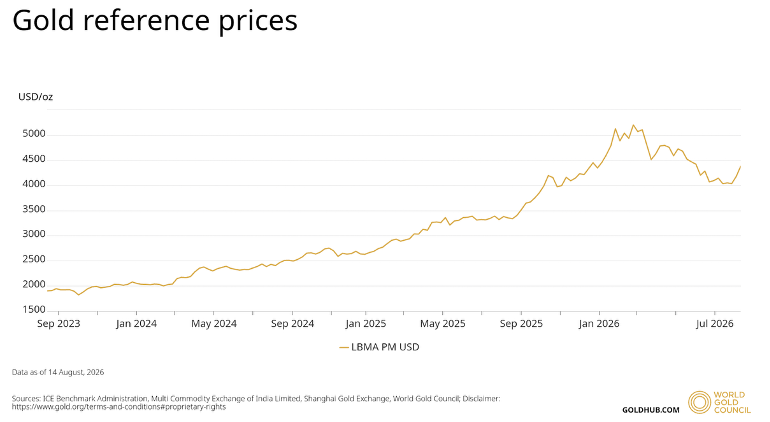
Week in Review (Gold Price – USD/oz)
• High: US$4,454.60
• Low: US$4,315.00
• Average: US$4,383.75
• Close: US$4,353.27
Gold traded within the US$4,380 – 4,400 per ounce range this week, recording a second consecutive weekly gain as softer US economic data reduced expectations of a Federal Reserve rate increase in September.
The market reached a weekly high of US$4,454.60 before closing at US$4,353.27. Although the close was below the weekly average of US$4,383.75, it remained above the previous week’s close of US$4,340.45 and reinforced the higher trading range established after gold broke out of its five-month consolidation.
A softer US employment report and cooler consumer and producer inflation data encouraged markets to reassess the likely path of interest rates. Weaker-than-expected July retail sales and a rise in weekly jobless claims added to evidence that the US economy is losing momentum.
Dorex CEO John Kochanski said gold’s resilience reflected a change in the balance of the pressures acting on the market.
“Gold did not need a dramatic new catalyst this week,” Mr Kochanski said, “just confirmation that the pressure from interest-rate expectations was beginning to ease, and the US data provided that confirmation.”
The move was not without resistance. Oil-price volatility and continuing tensions in the Middle East, particularly around the Strait of Hormuz, maintained an inflationary risk that limited a more aggressive breakout. A renewed rise in energy costs could complicate the Federal Reserve’s policy outlook even as employment and consumer data soften.
“The market is still balancing two competing forces,” Mr Kochanski said. “Softer growth and inflation data are supportive for gold, but any material disruption to energy markets could revive inflation concerns and place upward pressure on interest-rate expectations.”
Australian-listed gold equities did not fully participate in bullion’s strength. ASX gold sub-indices eased by approximately 2.4% as institutional capital rotated temporarily out of miners and into previously weakened technology stocks.
The divergence between bullion and listed gold companies appears more consistent with short-term sector rotation than a change in the underlying gold outlook. The metal remained within reach of its weekly high and comfortably above the levels that defined the earlier consolidation period.
“A firm gold price does not guarantee that gold equities will outperform every week,” Mr Kochanski said. “Capital moves between sectors, particularly after strong relative performance, but the underlying economics of the gold sector remain supported when bullion holds at these levels.”
Near-term direction is likely to depend on incoming US economic data, Federal Reserve commentary, movements in bond yields and the US Dollar, and developments affecting energy supply through the Strait of Hormuz.
Dorex continues to view gold primarily as a long-term store of value and strategic reserve asset rather than a short-term trading instrument.
“The important development is not simply that gold traded above US$4,450 during the week,” Mr Kochanski said. “It is that the market has held most of the gains from the previous week and established a higher base while expectations for rates, growth and geopolitical risk continue to change.”
“Gold’s second consecutive weekly gain reinforces the market’s higher trading range, with softer US data providing support while energy and geopolitical risks continue to limit a more decisive breakout,” said Mr Kochanski.
ENDS