
PRESS RELEASE: MeOH Weekly Liquid Fuel Markets Update – w/e 21.08.2026: A Tale of Two Markets:- Crude Eases as Hormuz Flows Recover, but Refined-Fuel Pressure Persists
• Global crude oil prices end week sharply lower; improving Gulf export flows reduce immediate supply anxiety; tight refining capacity and disrupted product supply continue to support petrol and diesel prices.
• Brent crude futures settled on Friday at US$89.31/Bbl, down more than 5%; West Texas Intermediate settled at US$83.40/Bbl, down more than 4%; evidence that more oil was leaving the Gulf region; flows remain well below pre-conflict levels; Strait of Hormuz outlook remains uncertain.
• Goldman Sachs estimated total Gulf exports of crude oil and petroleum products at 15-16m bbls/day – around two-thirds of pre-war levels; 5-6m bbls/day above the March low, but still 7-8m bbls/day below pre-war volumes.
CRUDE AND REFINED PRODUCTS MOVED DIFFERENTLY
Friday Close: Brent US$89.31/Bbl | WTI US$83.40/Bbl |
Weekly Averages to 26 August: Mogas 95 US$117/Bbl | Gasoil 10 ppm US$160/Bbl
The late-week sell-off in crude did not translate into an equivalent fall in refined fuel prices. The ACCC’s latest Australian market report, which uses seven-weekday averages to 26 August, recorded dated Brent at about US$94 a barrel, Singapore Mogas 95 at US$117 a barrel and Singapore Gasoil 10 ppm at US$160 a barrel. Compared with the previous week, Brent eased by about US$1, Mogas 95 was unchanged and Gasoil fell by about US$2.
This timing difference matters: the official Australian weekly averages ended on 26 August, before the full effect of Friday’s crude-price decline. It may therefore take time for any sustained easing in crude and refined product costs to flow through wholesale supply chains and into Australian retail prices.
Refining remained the key pressure point. Reuters reported that Russian gasoline production had fallen to about 70% of domestic consumption by late August after drone attacks forced major refineries to suspend operations. The disruption has required Russia to restrict sales and import petroleum products, reinforcing the broader shortage of flexible refining capacity.
A separate development late on Friday was the announced United States-Venezuela oil agreement covering fields said to contain more than 65 billion barrels of proven reserves. The proposal could become important for longer-term crude supply, but it does not provide immediate relief: its effect will depend on commercial terms, investment, infrastructure rehabilitation and implementation.
AUSTRALIAN PRICES REMAIN ELEVATED
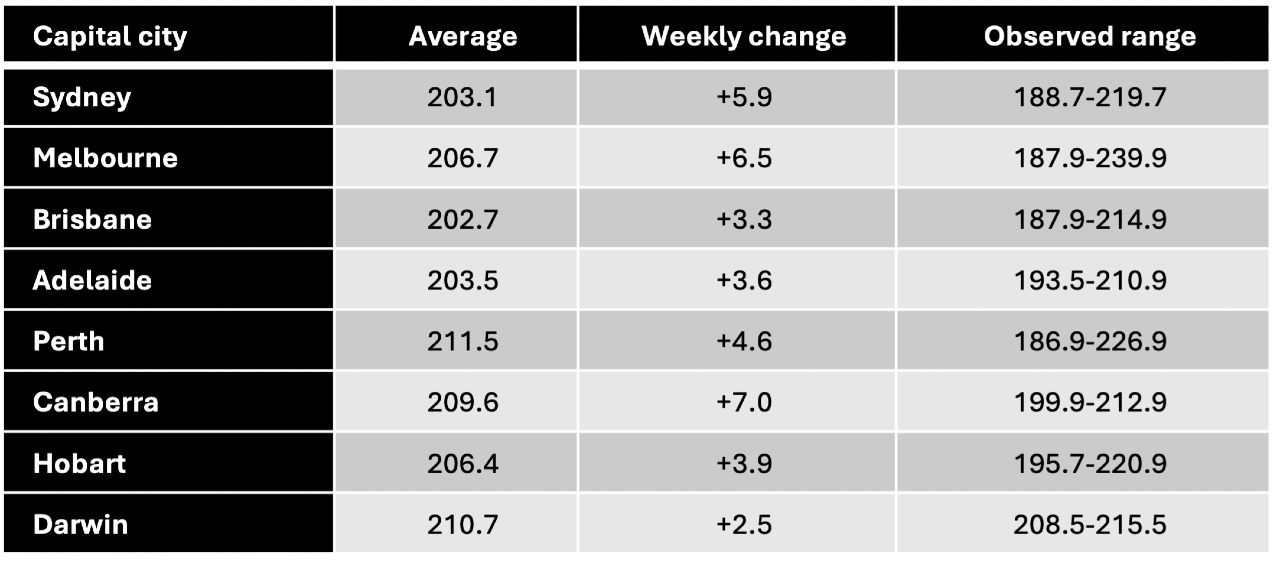
26 August: Retail ULP 91 205.5 c/L | Retail Diesel 250.2 c/L | Terminal Gate ULP 91 197.4 c/L | Terminal Gate Diesel 244.1 c/L
Australian motorists did not receive immediate relief during the reporting week. On 26 August, average regular unleaded petrol across the five largest capital cities was 205.5 cents per litre, up 4.8 cents from the previous week. Average retail diesel was 250.2 cents per litre, up 6.3 cents.
Average terminal gate prices across the five largest cities were 197.4 cents per litre for petrol and 244.1 cents per litre for diesel. These were weekly increases of 2.8 cents and 4.6 cents respectively. Terminal gate prices are useful indicators of wholesale movements, but actual transactions, transport costs, local competition and retail price cycles can produce materially different pump prices.
The full fuel excise was restored on 3 August. The excise rate is now 53.7 cents per litre; including the associated GST effect, the tax change could add up to 18.8 cents per litre. However, the ACCC found that retail movements also reflected international benchmark prices and local price cycles, rather than tax alone.
WHAT TO WATCH
The near-term direction of Australian prices will depend less on one day’s crude move than on whether higher Gulf flows are sustained, whether Singapore petrol and diesel benchmarks ease, how quickly wholesale changes reach retail sites, and where each major city sits in its local price cycle.
Diesel remains the greater risk for fuel-intensive sectors. On 26 August, the five-city retail diesel average was 44.7 cents per litre above petrol. That premium continues to affect agriculture, freight, mining, manufacturing and regional communities, where fuel costs are embedded across supply chains.
The week’s events reinforce Australia’s exposure to international crude routes, overseas refining capacity and imported refined fuels. MeOH Energy’s view is that sustained investment in Australian-made lower-emission liquid fuels would improve fuel security, retain more value in regional Australia and reduce the economy’s exposure to distant geopolitical and refining disruptions.
ENDS