
PRESS RELEASE: MeOH Weekly Liquid Fuel Markets Update – w/e 16.10.2026: Global Oil Prices Rise as America’s Diesel Conundrum Highlights Fuel Security Risks
Global crude oil markets recorded another week of significant volatility, with escalating geopolitical tensions in the Middle East driving prices higher, reinforcing concerns about the security of international petroleum supply chains and pointing to prolonged elevated prices.
For Australia, elevated international crude and refined fuel prices continue to translate into substantial costs for motorists, transport operators, agriculture and industry.
Global Crude Oil Prices at Close – w/e 16.10.2026 (USD/bbl)
Brent Crude $105.51
West Texas Intermediate (WTI) $97.43
Brent crude traded as high as US$108.51 during Friday’s session, while WTI exceeded US$100 per barrel earlier in the week. The Wall Street Journal reported Brent at US$109.86 and November WTI at US$101.41.
While reported prices vary with reporting times and market conventions, the substantial intraday movements highlight the increasing velocity of market uncertainty.
The sustained price pressure reflects the growing geopolitical risk premium associated with Middle East instability, particularly concerns surrounding the Strait of Hormuz, through which approximately one-fifth of global petroleum liquids consumption ordinarily passes.
Although international markets continue to respond to diplomatic developments and potential supply adjustments, the underlying uncertainty is encouraging traders to price additional risk into both crude oil and refined petroleum products.
Australian Domestic Fuel Prices
Australian wholesale and retail fuel prices remain elevated, reflecting international market conditions and the continuing cost of importing refined petroleum products.
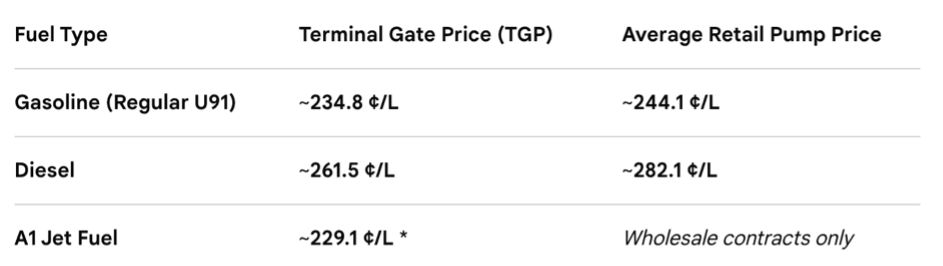
Indicative national prices for the week ended 16 October 2026 were:
Fuel W’sale TGP Av. Retail
Unleaded Petrol (U91) 234.8 ¢/L 244.1 ¢/L
Diesel 261.5 ¢/L 282.1 ¢/L
Jet A-1 Aviation Fuel 229.1 ¢/L –
Prices are indicative and subject to regional variations. Aviation fuel is generally supplied through commercial wholesale contracts only.
Diesel continues to command a substantial premium over petrol, reflecting tight international middle-distillate markets and sustained demand from freight transport, mining, agriculture and industrial operations.
The indicative difference between wholesale terminal gate prices and retail pump prices was 9.3 cents per litre for unleaded petrol and 20.6 cents per litre for diesel.
These differences are gross spreads rather than net retailer profits, incorporating distribution, operating and other costs.
For Australia’s transport-intensive economy, sustained diesel prices approaching $3.00 per litre represent a significant operating cost, with consequences extending through freight rates, food production, construction and consumer prices.
Middle East Conflict Maintains Supply Pressure
“The continuing Middle East conflict remains the dominant influence on international petroleum markets,” said MeOH Chairman Simon Tolhurst.
Disruption risks surrounding the Strait of Hormuz, together with heightened security concerns affecting regional energy infrastructure and maritime transport, have increased the cost and uncertainty of moving crude oil and refined products internationally.
Even where physical supplies remain available, higher shipping, insurance and financing costs can translate into increased delivered fuel prices.
The situation is particularly significant for Asian economies, including Australia, which rely heavily on imported crude oil and refined petroleum products.
Importantly, additional crude oil availability does not automatically translate into additional supplies of diesel, aviation fuel or petrol. Refining capacity, refinery configuration and distribution infrastructure all influence the availability of finished fuels.
The American Diesel Conundrum
The United States faces an increasingly complex diesel supply challenge, demonstrating that substantial domestic crude oil production does not necessarily guarantee affordable or readily available refined fuels.
American refineries produce significant volumes of diesel, but refinery configurations, regional demand patterns and distribution infrastructure can limit the industry’s ability to respond quickly to supply disruptions.
The US is actually a substantial net exporter of diesel. In 2025, its refineries produced approximately 1.76 billion barrels of ultra-low-sulphur diesel against domestic consumption of 1.42 billion barrels.
However, much of America’s refining capacity is concentrated along the Gulf Coast, while substantial diesel demand exists in the Northeast and Midwest.
Pipeline capacity and distribution constraints complicate the movement of refined products between these regions, leaving some markets dependent on imported fuel.
Adding to the challenge is the Jones Act of 1920, which requires cargo transported by sea between American ports to be carried on qualifying American-built, owned, flagged and crewed vessels. These restrictions increase domestic maritime transport costs and can make importing refined fuel commercially more attractive than shipping it between American ports.
Russian Diesel – Another Complication.
Russian refineries have historically been significant producers and exporters of diesel, particularly to European markets. While the original Western restrictions on Russian petroleum exports initially focused on crude oil – Dec 2022 – subsequent sanctions – Feb 2023 – extended to refined products, including diesel.
These measures fundamentally altered established international diesel trading patterns, forcing importers to source supplies from alternative markets and increasing competition for available production.
Recent developments involving the United States and Russian diesel exports have added a further political dimension, highlighting the competing priorities of energy affordability, geopolitical strategy and domestic economic and hence political pressures.
The result is an increasingly complicated international market where rising diesel demand, refinery constraints, disrupted trade flows and political intervention are all influencing prices.
With the Northern Hemisphere winter approaching, current elevated diesel prices may prove to be the new normal, at least through to the New Year.
Australia’s Domestic Fuel Security
“For Australia, the international situation reinforces a fundamental distinction between access to crude oil and access to the finished transportation fuels required to keep the economy operating,” said Mr Tolhurst.
Australia remains heavily dependent on imported refined petroleum products, leaving domestic fuel prices and supply availability exposed to international refining capacity, geopolitical instability and shipping disruptions.
MeOH Energy CEO Mick Spencer said the continuing volatility highlighted the importance of developing greater domestic transportation-fuel production capability.
“International crude oil availability is only one part of the equation. Refining capacity, distribution infrastructure and access to finished fuels are equally important to Australia’s energy security,” Mr Spencer said.
“The United States is demonstrating that even a major oil-producing nation can experience significant fuel supply and distribution challenges.”
“For Australia, the lesson is clear. We need to look beyond crude oil reserves and strengthen our capacity to produce the transportation fuels our economy actually consumes.”
MeOH Energy continues to advance its Australian transportation-fuels strategy, focused on converting domestic carbon-based feedstocks into valuable liquid fuels within a circular carbon economy.
“Storage provides a valuable buffer against short-term disruption, but it cannot replace the strategic value of domestic production,” Mr Spencer said.
“Australia cannot control international oil markets or geopolitical events. What we can control is our own backyard,” he said.
“Australia can control its’ investment in domestic fuel production capability and strengthen the resilience of our national supply chains.”
ENDS